Road Trip Communication: App vs Radio vs Chat
For most multi-car road trips, a live-map app is the best primary tool, with walkie-talkies as a backup where cell service dies. Group chat is the worst of the three: it demands that a driver read and type at speed. Radios give you instant voice but short range. A map answers “where is everyone?” without anybody touching a phone.
The short version
- Live-map app — best default. Everyone’s position updates continuously; no reading, no typing.
- Walkie-talkies — instant voice, no cell network needed, but FRS range is often under a mile in real terrain.
- Group chat — worst option while moving. Every message is an eyes-off-road event.
- Cost — an FCC GMRS license runs $35 for 10 years; a group-driving app’s free tier is $0 for up to 20 people.
- Best setup — a live map for position, radios for voice in dead zones, chat only at stops.
We tried all three on our own crew drives before building anything. Radios were fun for two cars and useless by the fifth, because someone was always out of range or had the volume down. Group chat produced the single scariest moment we’ve had: a driver reading a message and drifting toward a lane line. The map was the only option that told everyone what they needed without asking for their attention.
Which is better for a road trip: walkie-talkies, group chat, or an app?
An app with a shared live map wins for most groups, because the question drivers actually ask all day is positional, not conversational. “Where is everyone?” gets answered by a glance at a moving map. Walkie-talkies solve a narrower problem well — instant voice, no cell service required — but range collapses in hills and traffic, and every car needs a charged handset. Group chat fails the basic test of highway use: it requires reading and typing. The right answer for a group of four or more cars is usually a map as the always-on layer, radios kept in the glovebox for canyon roads and dead zones, and chat reserved for gas stops.
How well do walkie-talkies actually work on a road trip?
Better than their box claims suggest, worse than the “36-mile range” printed on it. Consumer walkie-talkies in the U.S. use the Family Radio Service, which the FCC licenses by rule: no license needed, 22 channels, and a 2-watt maximum on the higher-power channels (FCC, Family Radio Service). The FCC’s own guidance puts usual FRS range on channels 8–14 at under half a mile, with better results on channels 1–7 and 15–22 depending on conditions. Those advertised double-digit mileages assume line of sight between mountaintops. On a real highway with hills, buildings, and trucks between cars, a mile is a good day.
The step up is GMRS, which allows higher power and repeater use but requires an FCC license: $35, valid 10 years, no exam, and it covers your immediate family under one call sign (FCC, General Mobile Radio Service). For a crew that drives together often through poor-coverage terrain, that’s a reasonable buy. For one summer trip with friends who aren’t family members, the licensing math gets awkward fast.
Where group chat breaks down at highway speed
Group chat is the default because everyone already has it, and it’s the option most likely to cause a crash. The U.S. National Highway Traffic Safety Administration notes that taking your eyes off the road for the five seconds a text takes is, at 55 mph, like driving the length of a football field with your eyes closed (NHTSA). Multiply that by a thread where six people are answering “where are you?” and you have a group generating dozens of eyes-off-road events per hour.
There’s a second problem that has nothing to do with safety. Chat is a poor format for position. By the time someone types “just passed the second exit,” they haven’t. Text is a snapshot of a moment already gone, and it forces every other driver to reconstruct a mental map from stale fragments.
What a live-map app does differently
A live-map app replaces the question with the answer. Every car appears on one map and keeps moving, so a driver glances once and knows whether the group is bunched, strung out, or split. Nobody types. Group-driving apps like Vamio work this way: the crew joins one “drive” by invite link with no sign-up, and an hour-long drive uses roughly 5–10 MB of data — less than streaming a single song. The free plan holds up to 20 people on one live map at $0, and larger events split into multiple parallel drives. Location is shared only during the active drive and stops the moment it ends, with no background tracking, no data sale, and no ads (how we handle safety and privacy). For the urgent case there’s a one-tap SOS that alerts everyone in the drive with your exact location, plus in-drive chat for the non-urgent stuff.
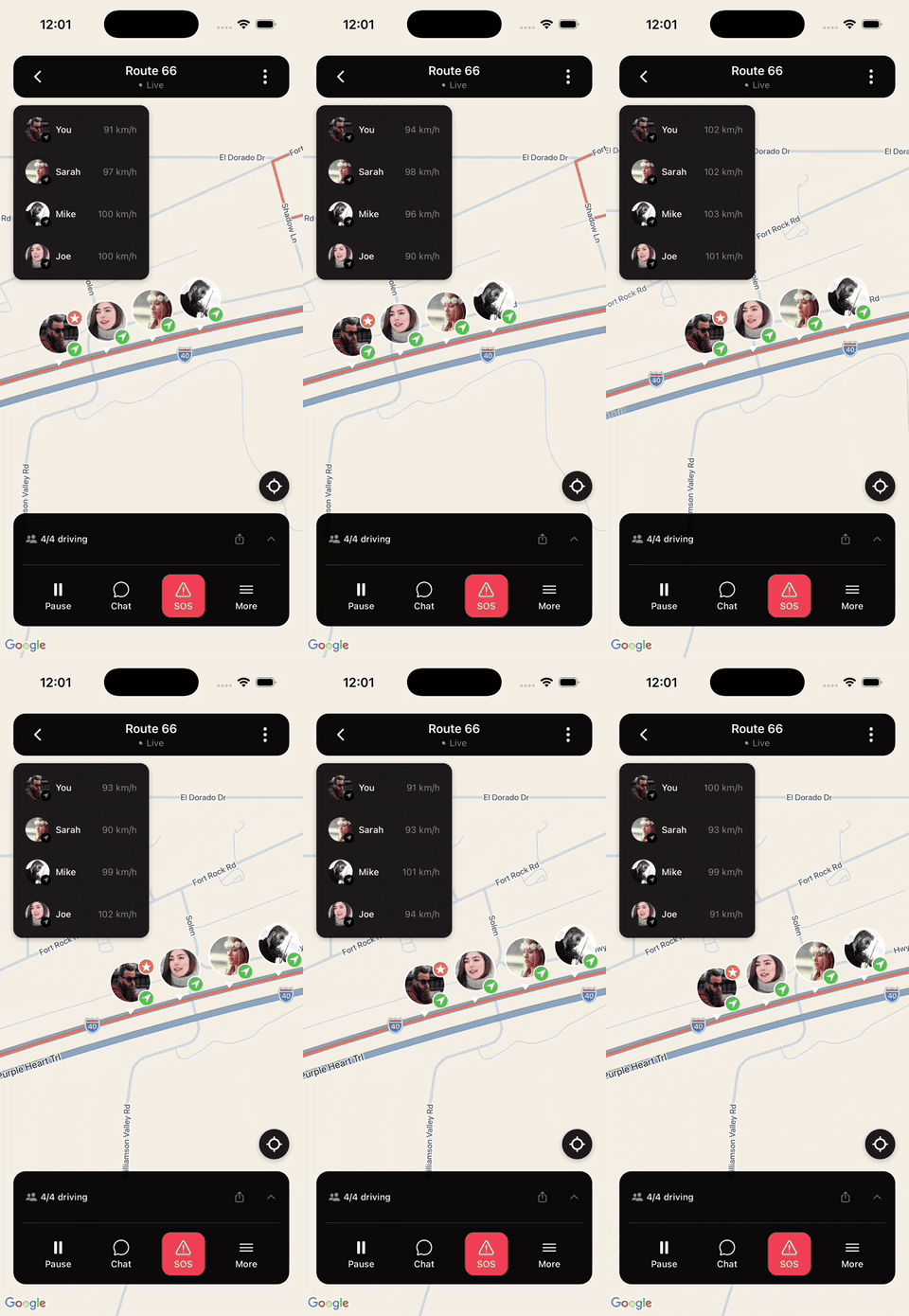
Side by side: range, cost, and hands-free use
| Walkie-talkies (FRS/GMRS) | Group chat | Live-map app | |
|---|---|---|---|
| Needs cell service | No | Yes | Yes |
| Typical range | Under 1 mile in terrain (FRS) | Anywhere with signal | Anywhere with signal |
| Hands-free while driving | Mostly (push-to-talk) | No | Yes — glance only |
| Answers “where is everyone?” | Only if you ask aloud | Poorly, and out of date | Continuously |
| Cost | $0 for FRS; $35 / 10 yrs for a GMRS license | $0 | $0 on the free tier, up to 20 people |
| Extra hardware | One handset per car, charged | None | None (iOS 16+, Android 10+) |
| Group size ceiling | Whoever’s in range | Unwieldy past ~6 | 20 per drive; split for more |
When walkie-talkies still win
Two situations, and they’re worth planning for. The first is genuine dead zones — mountain passes, desert stretches, national-park interiors — where no app works because no network exists. The second is convoy-style driving where cars need to talk continuously: a lead car calling out a hazard, a sweep car reporting the group has strung out. Push-to-talk voice is faster than anything on a screen for that, and it doesn’t ask a driver to look away.
Overlanding and off-road groups have run on radios for decades for exactly these reasons, and they’re right to. The mistake is treating radios as the whole system on a normal interstate trip, where their range limit becomes the thing that separates the group.
How should you combine them?
Layer them by job rather than picking one. Run through this before departure:
- Put every car on one live map — send the invite link the night before, not in the parking lot.
- Name your regroup points every 45–60 minutes, each a specific gas station or rest area.
- Assign a lead and a sweep car so the middle cars only track the vehicle ahead.
- Agree the separation rule — continue to the next regroup point and wait, don’t improvise.
- Agree the emergency rule — send the one-tap SOS; the group comes to you.
- Hand out radios if your route has dead zones, and set the channel before you start driving.
- Mount and charge every phone — nobody holds a device.
- Keep chat for stops. Anything urgent goes to voice or SOS, never a thread.
The layering is the whole trick. Let the map carry position for the entire drive. Radios cover voice on the stretches where no network reaches. Everything else can wait until the group is parked.
For more on holding formation once you’re rolling, see how to keep a group together on a road trip, or work through the full group road-trip planning checklist.
Set up your road-trip communication before the next drive
Vamio is a free group-driving app for road trips and convoys on iOS 16+ and Android 10+. Start a drive, share one invite link — no sign-up needed for your crew to join — and everyone rides on one live map from departure to destination. Download Vamio, then decide whether your route needs radios on top.
